
A beginner's guide
Learn about curling.
The sheet, the stones, the sweeping and the scoring — everything you need to follow a game, explained without the rulebook jargon.
01The idea
Two teams. One target.
Curling is played between two teams who take turns sliding heavy stones down a long sheet of ice toward a circular target called the house. The goal: finish each round with your stones closer to the center — the button — than any of your opponent's.
In traditional curling each team has four players, and every player delivers two stones per round, so sixteen stones are thrown in all. Mixed doubles, a faster two-player format, uses fewer stones and a few special rules. Either way, it's a game of precision, planning and teamwork.
02The playing field
Meet the sheet
A curling sheet is a long, narrow strip of ice — roughly 150 feet from end to end — with a house painted near each end. The ice is sprayed with fine water droplets called pebble, which is what lets the stones glide and curl.
- Hack
- Rubber footholds at each end that players push off from when delivering a stone.
- Hog line
- A line the stone must be released before — and must fully cross to stay in play.
- House
- The target of concentric rings. Only stones in or touching the house can score.
- Button
- The small center circle of the house — the bullseye everyone is aiming for.
03The stone
Granite, a gentle turn, and a curl.
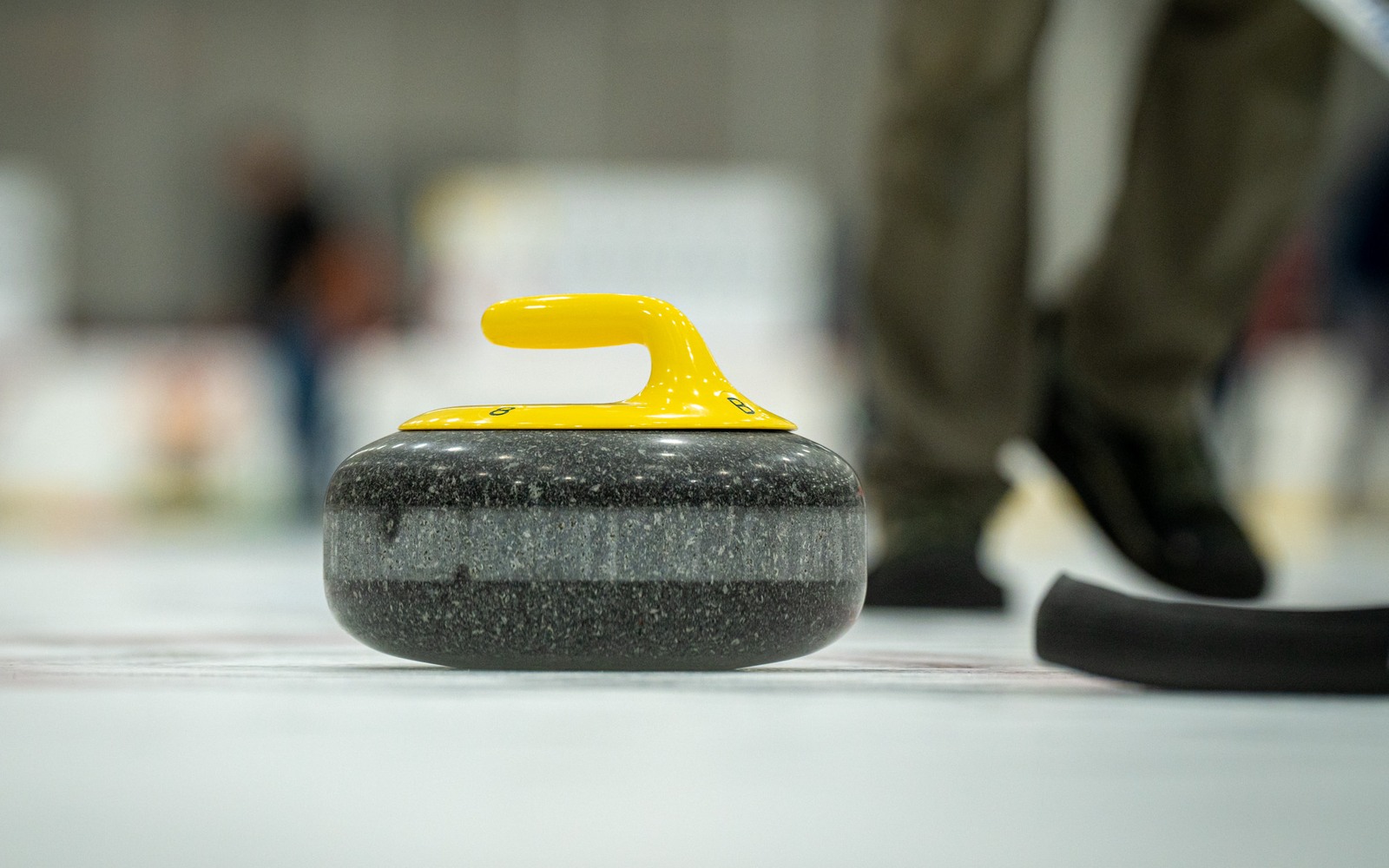
Curling stones are made of granite and weigh about 40 pounds. As a player slides out of the hack and releases the stone, they give the handle a slow rotation. That turn makes the stone drift, or curl, as it slows down — which is how the sport got its name.
Most shots fall into three families:
- Draw
- A stone thrown to stop in a particular spot, usually in or near the house.
- Guard
- A stone placed in front of the house to protect a stone behind it.
- Takeout
- A harder throw meant to knock an opponent's stone out of play.
04Sweeping
Brooms with a purpose.
Once a stone is released, teammates can sweep the ice in front of it. Brisk sweeping briefly warms and smooths the surface, reducing friction so the stone tends to travel farther and curl less.
Sweepers watch the stone closely and listen for calls from the thrower and skip about weight (speed) and line. It's hard work and a skill of its own — knowing when to sweep matters as much as how.
05Ends & scoring
How a team puts up points
A game is divided into rounds called ends. Once all sixteen stones have been thrown, the end is scored — then play reverses direction for the next end.
- Only one team can score in an end — the team with the stone closest to the button.
- That team earns one point for every stone in or touching the house that sits closer to the button than the opponent's closest stone.
- If no stones are in the house, nobody scores. That's called a blank end.
Quick example
When the last stone stops, the Red Team has the stone nearest the button and another just behind it. The Yellow Team's best stone is third-closest. The Red Team scores two points; the Yellow Team scores none.
06The team
Who does what
Lead
Throws the first two stones of each end — often guards or draws that set up the play — then sweeps.
Second
Throws the third and fourth stones, frequently takeouts, and does plenty of sweeping.
Third
Throws the fifth and sixth stones, helps the skip read the ice, and holds the broom when the skip delivers.
Fourth / Skip
Usually the team captain, calling strategy and directing shots from the house. Typically throws the final two stones, often under the most pressure.
07Strategy
The hammer
The last stone of an end is called the hammer, and having it is a real advantage: you get the final say on where things stand. The team that doesn't score in an end usually gets the hammer in the next.
Much of curling strategy revolves around it. With the hammer, teams often try to score two points or more; without it, they try to limit the damage or force their opponent to settle for a single point.
08Sportsmanship
The spirit of curling
Curling takes pride in good conduct. Games traditionally begin and end with a handshake, players call their own infractions, and good shots get applause from both teams.
Just as important is what curlers don't do: celebrating an opponent's mistake isn't part of the game. Play hard, play fair, and be gracious either way.
09Getting started
Your first time on the ice
- Dress in warm layers you can move freely in — stretchy pants and a light jacket work well.
- Wear clean, flat, rubber-soled shoes that haven't been worn outside, so the ice stays clean and you stay steady.
- Listen to your instructor and follow their safety guidance — ice is slippery, and good balance habits come first.
- Expect to laugh. Nearly everyone wobbles at first, and that's part of the fun.
Want to know more about curling in Tulsa? Reach out — our volunteers are happy to answer questions.